The 1:47AM Problem
plz don't text that yet

apparently the internet spent 15 yrs crowdsourcing relationship advice and somehow kept converging on the same answer, "LEAVE."
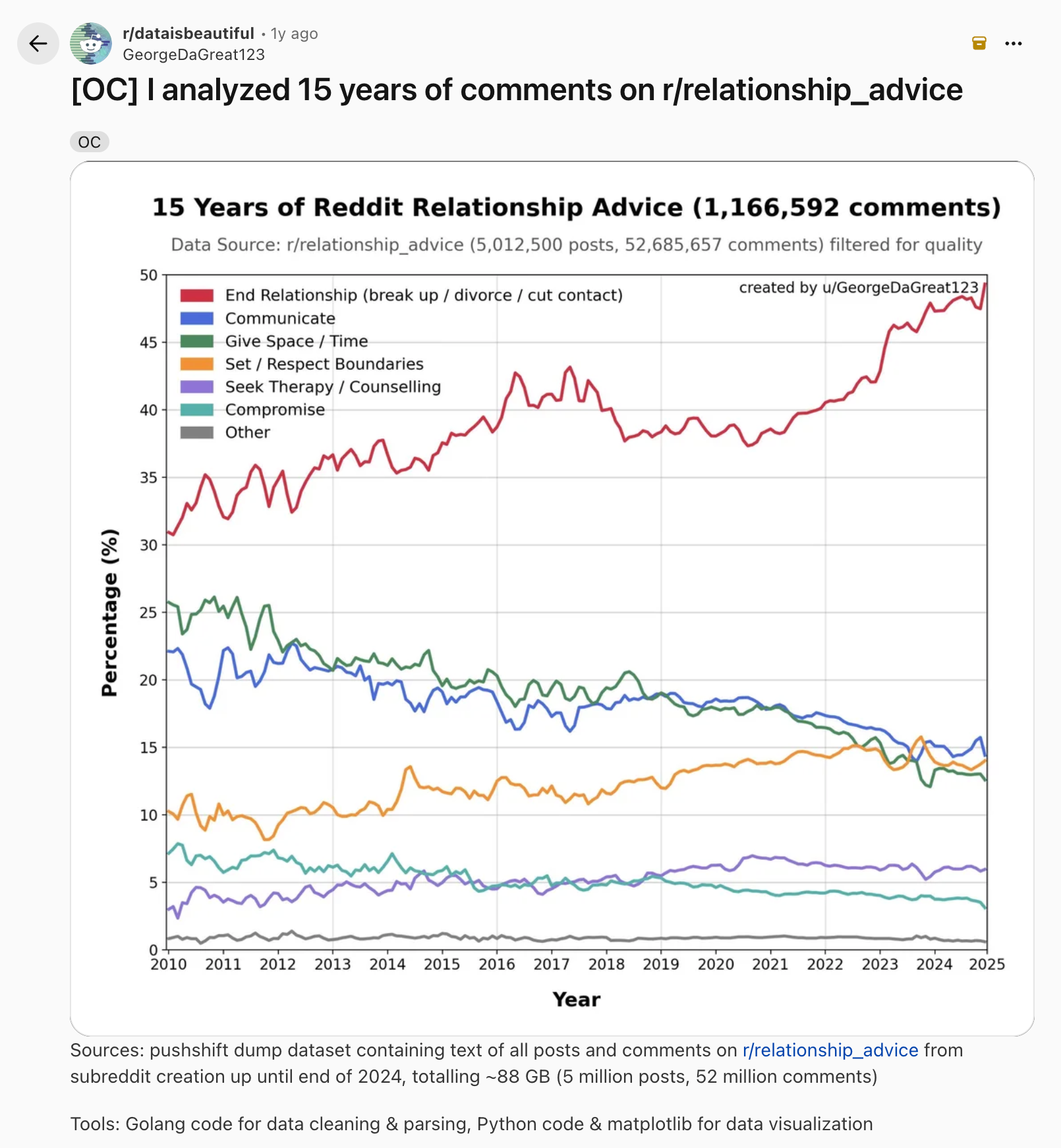
this analysis of r/relationship_advice is hard to unsee. "end relationship" goes from ~30% of the categorized advice in 2010 to almost half by 2025. meanwhile communicate, compromise, give space, ... basically every answer that involves staying together keeps losing ground.
"ppl online have come too cynical!"
guess that's the easy read here, but it only gets u so far.
r/relationship_advice is obviously a very selected sample. happy couples generally don't wake up and write 500 words for strangers about how normal their breakfast was.
what gets me more is what happens once a whole relationship gets squeezed into a story strangers are supposed to judge.
you don't upload a relationship to reddit. u upload a narrative.
six years of breakfasts, inside jokes, built-up resentment, dumb compromises, shitty timing, moving goalposts & totally uneventful wednesdays get compressed into: "my gf did this last night. am i cooked"
your relationship was lived in 4k ultra hdr dolby vision, but the audience gets ~1,000 words at most.
and humans are pretty bad at preserving proportion once emotion gets involved. the latest fight is vivid while the five boring but peaceful months before it aren't. we overweight what is salient especially when we're angry, scared or embarrassed.
then the stranger reading it gets an even cleaner version -> one side, one moment, no history & basically zero downside if the advice is ass (worst case OP comes back like "bro u literally made this worse").
under those conditions, "leave" is almost too perfect for the internet.
it gives u certainty. it validates the person asking. it gives the story a villain, a conclusion & an action item.
"talk it out, sleep on it, see if it happens again, then decide when ur not pissed" may be better advice sometimes. it just doesn't nearly hit as hard as "leave."
we say we want advice. quite often what we actually want is relief from having to sit w/ uncertainty.
and that's where i find myself making a case for ai, almost against my better judgment.
not because it's necessarily wiser than your friends, or because we need a robot couples therapist. its advantage may be much more boring than that: it can << remember >>.
a random reddit commenter sees the screenshot.
a persistent ai could, tho with the obvious privacy caveats, see sth closer to the whole movie. the buildup, the quiet stretches, the recurring fights, the stuff u said before the latest blowup made everything else feel irrelevant.
it could remember that after the march fight u also said "i'm done", and regretted sending it the next morning.
or that three months ago u said "if this happens again, i clearly need to stop treating it like an exception."
those are very different interventions. which means the point isn't necessarily getting ai to say "stay" or "leave."
maybe it says "you're heated rn. last time u were this mad, morning-u had a completely different take. maybe don't make the life-altering call this late at night?"
or, just as importantly: "this is literally the 13th time. three months ago u called it a boundary. why r we still pretending it's an exception?"
that's less << ai relationship guru >> than sth closer to << memory as agency >>.
humans are weirdly discontinuous creatures. the person rage-texting at 1:47am is technically the same person drinking coffee at 9:13am the next morning, but the two can have radically different preferences.
good advice may sometimes be nothing more mystical than a temporary loan of a calmer mind. and maybe ai can lend us back our own.
this is also where the ai convo gets more interesting to me than the usual "which model is smartest" stuff.
there may be whole categories where the killer feature isn't intelligence but << longitudinality >>.
human attention is episodic & expensive.
machine attention can be persistent & cheap.
ur friend gets tired of hearing about the same fight for the 33rd time.
the machine doesn't (at least till it achieves sentience & also gets tired of ur shit).
ur friend remembers the parts that stood out.
the machine can remember the whole damn pattern.
and maybe most importantly, a well-designed system doesn't have to optimize for making u feel better rn.
it could put just enough friction to stop a 1:46am spiral from becoming a 1:47am decision.
which can obviously go in two very different directions.
the useful version uses memory to call bullshit on whatever story feels true rn -> "u said the exact opposite three months ago." "this feels unprecedented cuz ur furious." "nth about the last six months suggests this came out of nowhere."
the bad ver. just gets insanely good at arguing ur side.
if it only hears your account of every fight, then gets rewarded for keeping u engaged, reassured & feeling understood, you've basically built the world's most convincing yes-man.
same perfect memory, different job. one gives u context. the other makes ur confirmation bias sound well-researched.
give that second ver. the same internet this chart came from and << relationship intelligence >> could just end up as reddit w/ memory.
so the real product question probably isn't whether ppl will ask ai for relationship advice cuz they will.
it's what the thing is optimizing for once u start venting.
- validate me?
- calm me down?
- keep me yapping?
- keep us together?
- or actually help me think straight enough to make the call myself?
those all sound pretty compatible until the machine has to pick one.
 Madison Griffiths
go on then. click it
we've spent a lot of time imagining ai as another participant in human relationships -> ai gf, ai bf, synthetic situationship, emotionally literate sex doll, whatever comes after character.ai gets legs.
i wonder if one of the more useful versions ends up being almost the inverse. not another person in the relationship, just sth quietly sitting around it like the relationship's external hard drive.
the memory, the cool-off, the text u almost sent, the "we've literally had this fight before." or, just as usefully, the "nah. this one actually is different."